Project: Jet Engine RUL Prediction
Project Overview
A Deep Learning-based Predictive Maintenance System for jet engines using 1D Convolutional Neural Networks (CNN). The model predicts the Remaining Useful Life (RUL) of turbofan jet engines, enabling proactive maintenance scheduling and preventing unexpected failures.
Aircraft engine failures can lead to catastrophic consequences. This project implements Predictive Maintenance - predicting when an engine will fail so maintenance can be performed just-in-time, moving beyond reactive (fixing after failure) and preventive (scheduled maintenance) approaches.
Problem Statement
Traditional maintenance approaches are either reactive (dangerous and costly) or preventive (often wasteful). This system predicts the exact remaining cycles until engine failure using sensor data, enabling optimal maintenance scheduling.
Dataset
NASA C-MAPSS (Commercial Modular Aero-Propulsion System Simulation) Dataset featuring:
- 4 datasets (FD001-FD004) with 100-260 training engines each
- 21 sensor measurements: temperature, pressure, speed, and operational parameters
- 3 operational settings: altitude, Mach number, throttle resolver angle
- Multiple operating conditions and fault modes (HPC & Fan Degradation)
Technical Approach
- Data Preprocessing: RUL calculation, capping at 125 cycles, feature selection, MinMaxScaler normalization
- Sequence Generation: Sliding window approach with 50 time steps
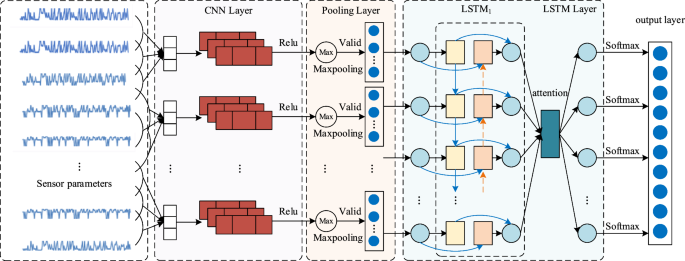
- Model Architecture: 3 Conv1D blocks (64→128→256 filters) with BatchNorm, MaxPooling, Dropout, followed by Dense layers (200→100→1)
- Training: Adam optimizer, MSE loss, 200 epochs with early stopping (patience=15)
Key Features
- 1D CNN architecture optimized for time-series sensor data
- Multi-dataset support for all 4 C-MAPSS datasets
- Comprehensive evaluation with regression & classification metrics
- NASA's asymmetric C-MAPSS scoring function implementation
- Production-ready pipeline with saved models, scalers, and metrics
- Visualization suite: training curves, prediction plots, error distributions
Evaluation Metrics
- Regression: RMSE, MAE, R² Score
- Classification: Accuracy, Precision, Recall, F1-Score (RUL < 25 = "Failure Imminent")
- C-MAPSS Score: Asymmetric scoring penalizing late predictions more heavily